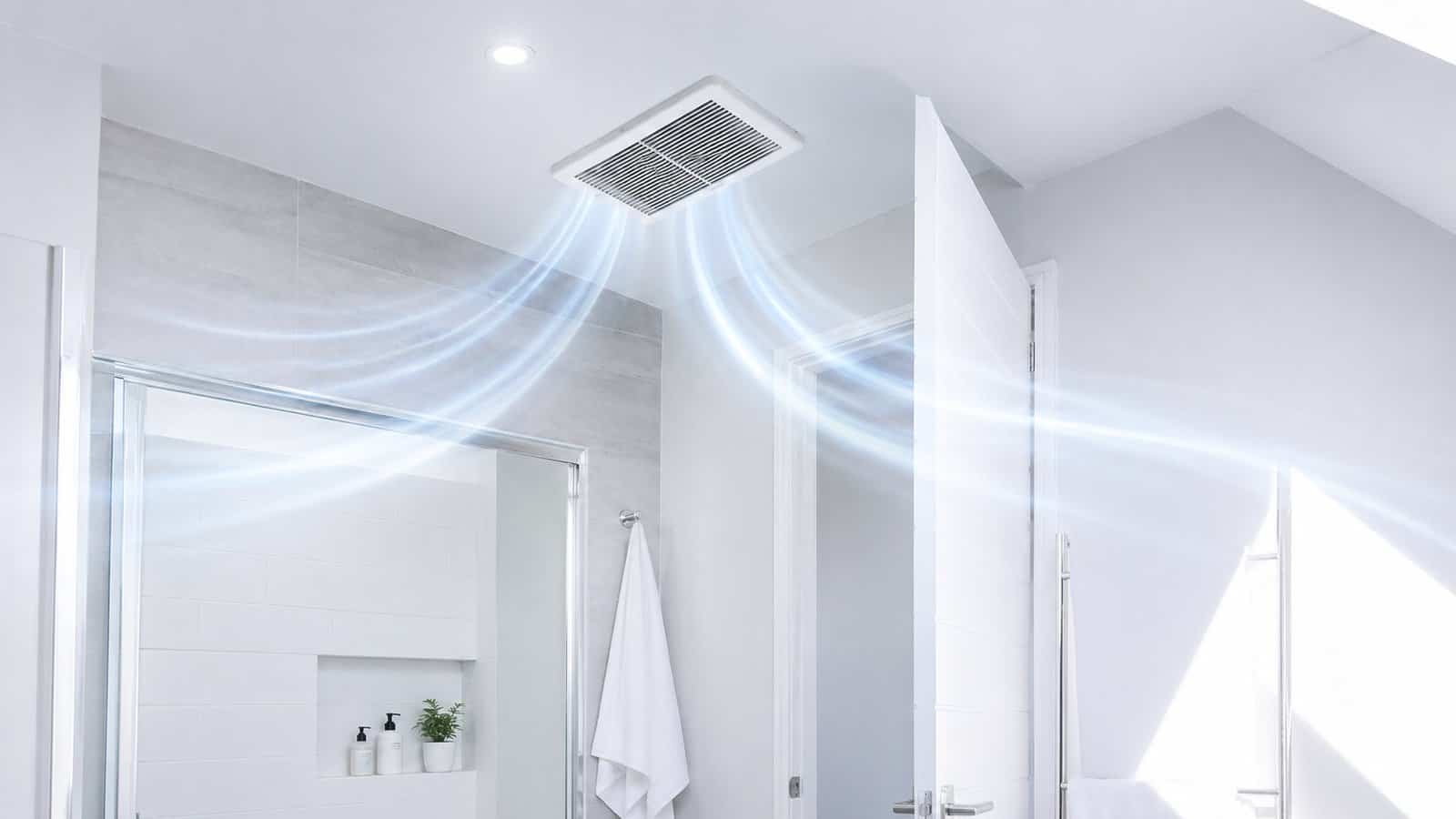
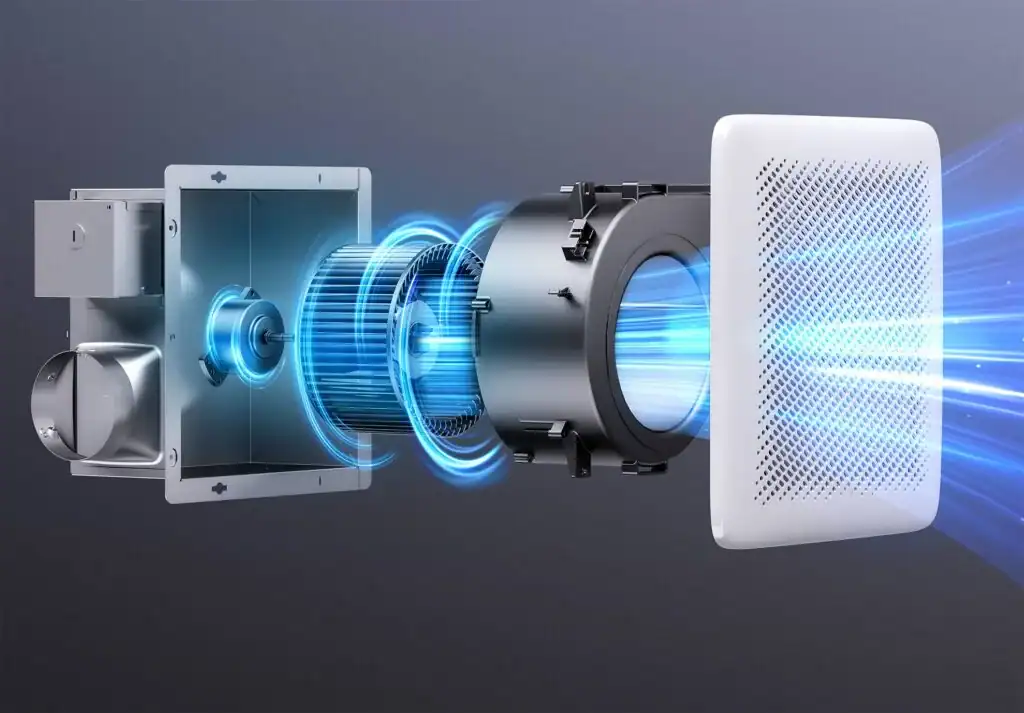
When selecting the right ventilation system for residential or commercial projects, the choice between an AC (Alternating Current) and a DC (Direct Current) motor is the most critical technical decision. While AC fans have been the industry standard for decades, DC motor technology is rapidly becoming the preferred choice for modern bathroom ventilation.
At BFF, we specialize in high-efficiency DC systems. This guide compares both technologies to help you determine the best ROI for your project. If you are still deciding on fan size first, see our bathroom fan CFM sizing guide before reading on.
1. AC vs DC Exhaust Fan Energy Efficiency: Lowering the Total Cost of Ownership
In a bathroom setting, bathroom exhaust fans often run for extended periods to clear humidity.
- AC Fans: These use induction motors that generate significant heat, wasting up to 50% of the energy consumed.
- DC Fans: BFF DC motors use permanent magnets, consuming 40–60% less energy. For a B2B project (like a hotel or apartment complex), this translates to thousands of dollars saved in annual energy costs.
For context: a typical AC bathroom fan draws 25–40W continuously. A DC equivalent draws just 8–15W. Across 100 hotel rooms running 8 hours daily, that difference exceeds 3,000 kWh per year.
2. Moisture Control: The "Constant CFM" Advantage
Bathrooms are high-resistance environments due to narrow ductwork and external vents.
- AC Performance: As static pressure (resistance) increases in the duct, an AC motor slows down, drastically reducing actual airflow and leaving moisture trapped in the room.
- DC Intelligence: Our Smart DC technology monitors duct resistance and automatically increases RPM to maintain a constant CFM. This ensures moisture is effectively removed, preventing mold and protecting building integrity.
If moisture control is your top priority, also consider pairing a DC fan with an automatic humidity sensor — the fan activates the moment humidity rises, without any manual switching.
3. Noise Levels: Achieving the "Ultra-Quiet" Standard
Bathroom comfort is often measured by acoustics.
- AC Hum: AC motors are prone to a 60Hz electrical hum that can be intrusive in quiet residential settings.
- DC Silence: Because DC motors eliminate electrical vibration and offer a soft-start feature, they operate at whisper-quiet levels (as low as 0.8 to 1.5 Sones). This is a major selling point for luxury hospitality and high-end residential developments.
For comparison, a normal conversation is about 3 Sones. Our ultra quiet DC bathroom exhaust fans operate at 0.8–1.5 Sones — barely audible. See our full breakdown of ultra quiet bathroom exhaust fans with light for more on noise ratings.
4. AC vs DC Exhaust Fan Durability in Humid Environments
The bathroom is a harsh environment with high humidity levels.
- AC Motors: Higher operating temperatures can lead to faster bearing wear and shorter lifespans (~15,000 hours).
- BFF DC Motors: With a brushless design and lower thermal output, our motors are rated for 50,000+ hours of maintenance-free operation, reducing the need for costly replacements in commercial facilities.
5. Installation: Ceiling Mount or Wall Mount?
Both AC and DC fans are available in ceiling and wall mount configurations. The choice depends on your building structure, not the motor type. For a full breakdown, read our guide: Ceiling Mount vs Wall Mount Bath Fans — Which Should You Choose?
Comparison Matrix: AC vs DC Exhaust Fan for Professional Use
| Feature | AC Exhaust Fans | BFF DC Exhaust Fans |
|---|---|---|
| Energy Efficiency | Low (25–40W typical) | High (8–15W typical) |
| Noise (Acoustics) | 2.5 – 4.0 Sones | 0.8 – 1.5 Sones |
| Static Pressure | Airflow drops significantly | Smart Airflow Compensation |
| Service Life | 10,000 – 15,000 Hours | 50,000+ Hours |
| Smart Integration | Limited | Supports Humidity / Motion Sensors |
| Upfront Cost | Lower | Higher (ROI within 18–24 months) |
| CFM Sizes Available | 80–110 CFM typical | 50–110 CFM, adjustable |
When Does an AC Fan Still Make Sense?
To be fair, AC exhaust fans are not obsolete. In certain scenarios, they remain a practical choice:
Tight Upfront Budgets: If you are working on a small-scale project with immediate cost constraints — such as a single-family home renovation or a quick-flip property — an AC bathroom exhaust fan carries a lower purchase price.
Short-Term Installations: For temporary structures or projects where the ventilation system will be replaced within 2–3 years, the long-term energy savings of DC may not fully materialize.
Retrofit Compatibility: Some older buildings have electrical setups optimized for AC motors. Contractors working on quick retrofits may prefer to swap an old AC unit with a new AC unit to avoid any reconfiguration.
The Break-Even Math: For any project with a horizon beyond 2–3 years, the calculus flips. A DC bathroom exhaust fan consuming 40–60% less energy typically recovers its price premium within 18–24 months. For multi-unit properties — hotels, apartments, senior living facilities — the cumulative savings across dozens or hundreds of units become a significant line item.
DC Fan CFM Options: Matching the Right Size to Your Bathroom
Not sure which CFM rating to specify? Here is a quick reference:
- 50–80 CFM: Bathrooms under 75 sq. ft.
- 100–110 CFM: Bathrooms up to 110 sq. ft., or rooms with jetted tubs
- For a detailed guide, see: 80 CFM vs 100 CFM bathroom fans and 100 CFM vs 110 CFM exhaust fans
The Verdict: Which Is Better?
For budget-sensitive, short-term projects, AC fans may offer a lower initial cost. However, for professional B2B applications — where energy efficiency, noise reduction, and moisture-guard performance are paramount — DC exhaust fans are the superior choice.
BFF B2B Support: As a leading exhaust fan manufacturer, we provide high-performance DC ventilation solutions tailored for the North American market.
- Certifications: ETL, Energy Star, and HVI 2100 compliant.
- Customization: Full OEM/ODM services for motor performance and housing design. See our wholesale & OEM page.
- Product Range: Browse all bathroom exhaust fans or go directly to our 12 inch DC ultra quiet exhaust fan.
Yes, for B2B projects the 40-60% energy savings typically recover the cost difference within 2-3 years. With 50,000+ hour lifespans, DC fans also reduce replacement frequency in commercial settings.
Yes. Most DC models are designed to fit standard ceiling and wall openings. The wiring is also compatible — no special electrical work required.
Yes. BFF DC motors fully support humidity sensor and motion sensor integration, making them ideal for smart building automation projects.