If you're trying to decide between a 100 CFM and a 110 CFM bathroom exhaust fan, you might wonder if an extra 10 CFM is worth thinking about. The answer depends on your bathroom size, your duct setup, and how you use the space.
What 100 CFM Covers
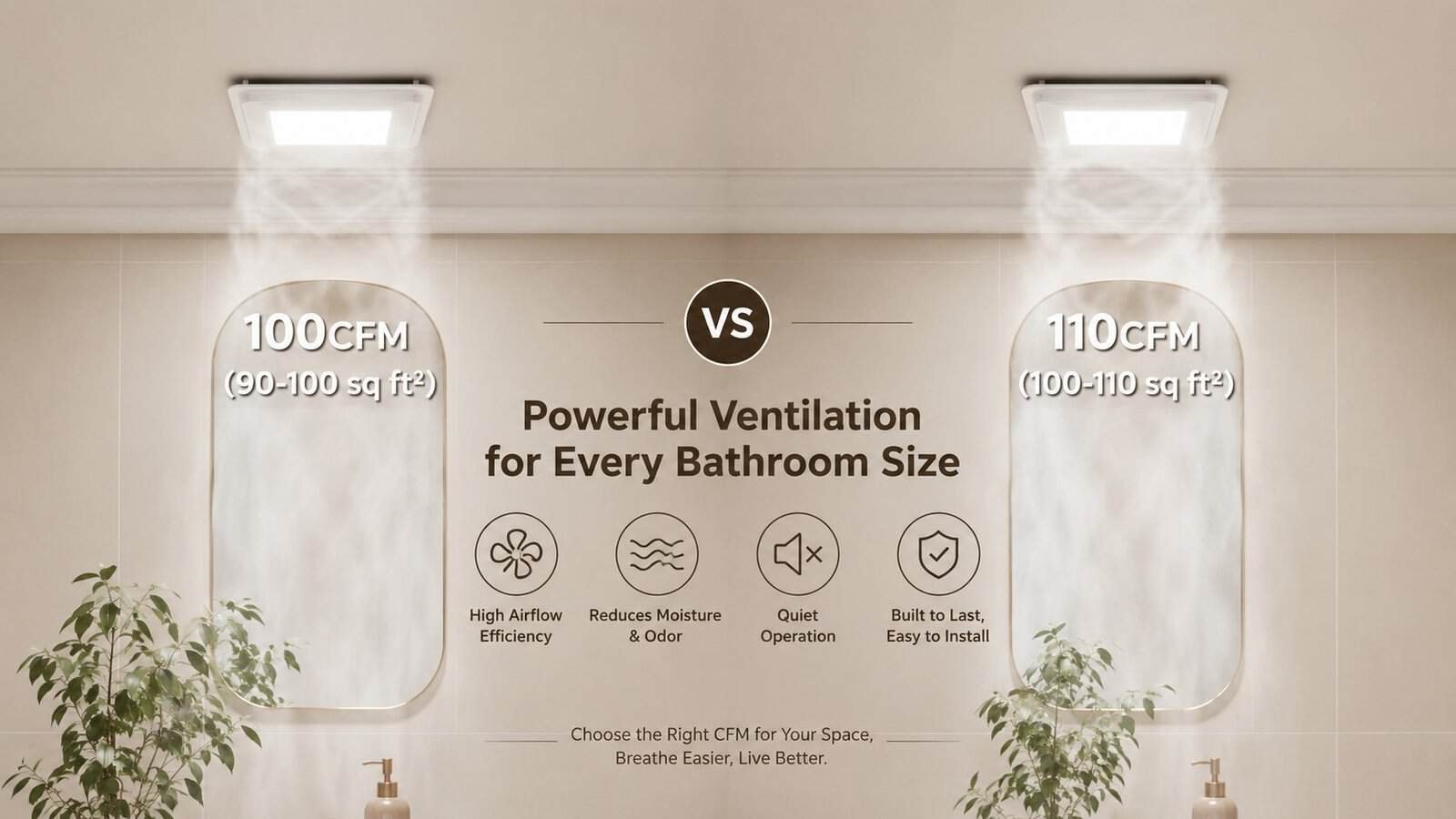
The standard rule — 1 CFM per square foot, minimum 50 — means a 100 CFM bath fan is properly sized for bathrooms up to 100 square feet. That covers the vast majority of residential bathrooms built in the last 30 years.
For bathrooms at the upper end of this range, our 110 CFM model handles up to 110 square feet with margin to spare.
What 110 CFM Adds
An extra 10 CFM might seem trivial, but it makes a difference in three situations:
- Long duct runs — Every foot of duct and every bend reduces effective airflow. 110 CFM gives you a cushion that 100 CFM doesn't.
- Steam-heavy bathrooms — Multiple shower heads, deep soaking tubs, or humid climates need the extra capacity.
- Margin for real-world loss — No fan performs at exactly its labeled CFM once installed. 110 CFM rated might deliver close to 100 in practice. 100 CFM rated might deliver closer to 90.
Side-by-Side Comparison
| 100 CFM | 110 CFM | |
|---|---|---|
| Max bathroom size | 100 sq ft | 110 sq ft |
| Air changes per hour (100 sq ft room) | ~7.5 | ~8.3 |
| Duct diameter (typical) | 4 or 6 inch | 6 inch |
| Price difference | Baseline | Typically $5–15 more |
| Best for | Standard bathrooms with short duct runs | Larger or high-moisture bathrooms |
When 100 CFM Is Enough
If your bathroom is under 100 square feet and your duct run is short (under 10 feet with minimal bends), 100 CFM will do the job. You won't notice the missing 10 CFM in daily use. Our 10-inch DC quiet model delivers 100 CFM-level airflow with less noise and lower energy use than standard AC fans.
When to Step Up to 110 CFM
Go with 110 CFM if your bathroom is between 100–110 square feet, your duct run is long or has multiple bends, or you have a steam shower or deep soaking tub. At a $5–15 price difference, stepping up to 110 CFM is usually the safer bet.
Bottom Line
For most bathrooms, 110 CFM is the sweet spot. If your bathroom is firmly under 80 square feet, 100 CFM is fine. But if you're on the fence, the extra 10 CFM costs very little and buys you peace of mind.
CFM stands for cubic feet per minute. It measures how much air a fan moves in one minute. The higher the CFM, the more moisture and odors the fan can extract from your bathroom. For most residential bathrooms, you need between 50 and 110 CFM, depending on room size.Yes, if your bathroom is under 100 square feet and your duct run is short, a 100 CFM bath fan is sufficient. It moves enough air to clear moisture after a shower and meet most building code minimums. If your bathroom is larger or has a long duct run, consider stepping up to 110 CFM.The difference is 10 CFM of airflow capacity. In practice, a 110 CFM fan can handle a slightly larger bathroom (up to 110 sq ft vs 100 sq ft) and provides extra margin for duct resistance, which reduces real-world performance. The price difference is usually only $5–15.Yes. 110 CFM covers bathrooms up to 110 square feet and is the most versatile size for medium-to-large residential bathrooms. It provides enough power for daily use with a comfortable margin for steam-heavy showers or longer duct runs. <a href="/product/bathroom-exhaust-fan-110-cfm/">Our 110 CFM fan</a> is a popular choice for exactly this reason.