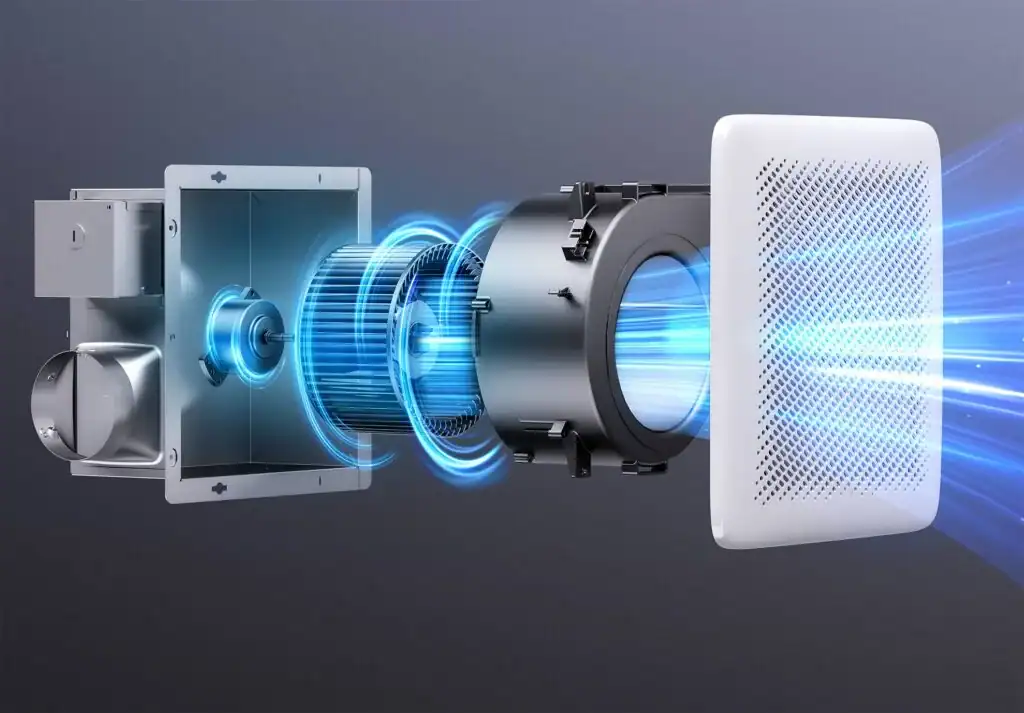
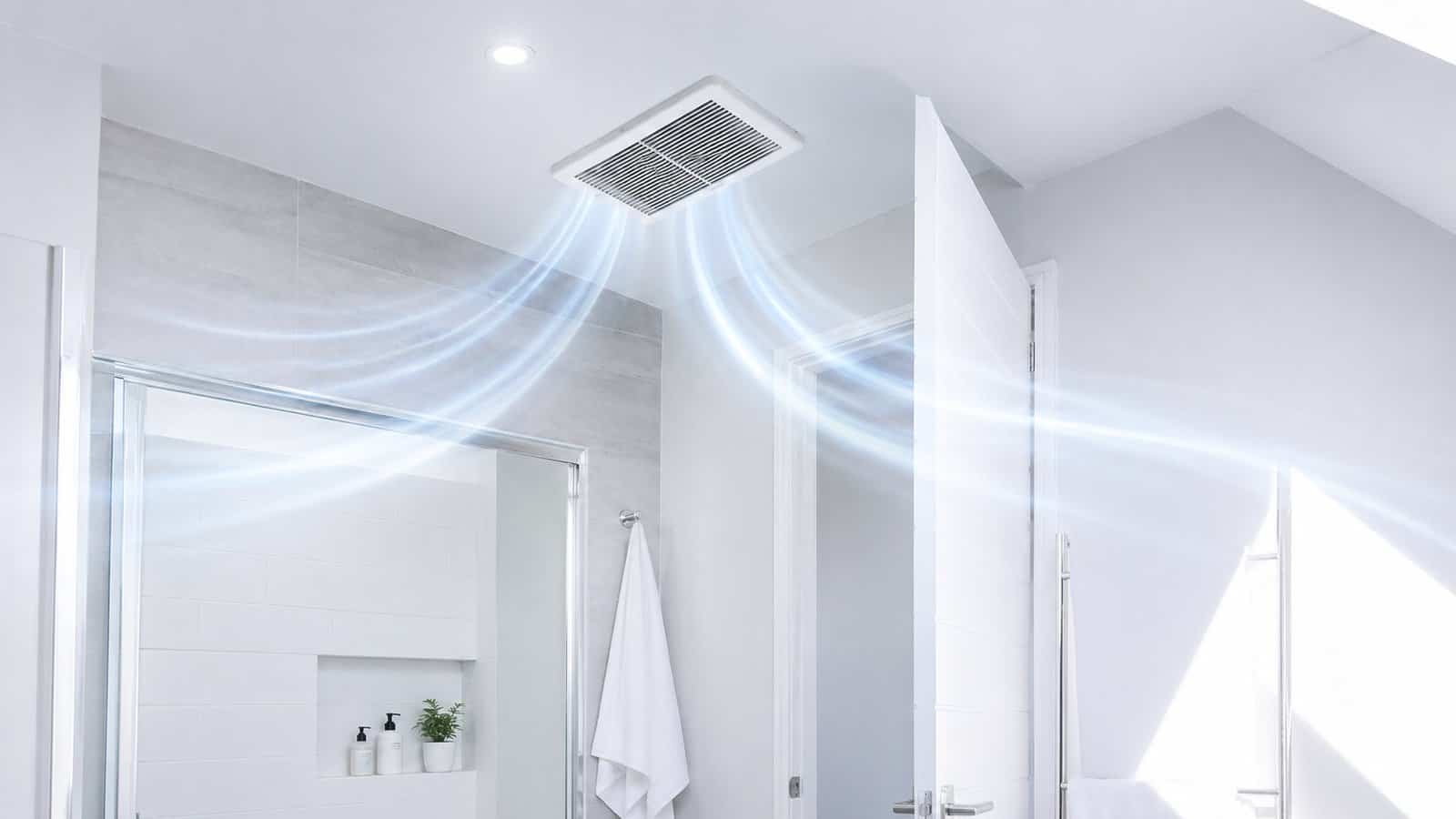
In the professional HVAC business, we see it all the time: a high-spec fan underperforming because of a bad install choice. For B2B projects, picking between a ceiling mount vs wall mount bath fan isn't just about where it fits — it's about protecting your airflow efficiency and staying compliant with standards like HVI 2100.
Not sure what CFM you need before deciding on mount type? Start with our bathroom fan CFM sizing guide.
Understanding the Physics of Bathroom Ventilation
Steam and heat rise — it's that simple. To maximize extraction efficiency, the installation must work with these physical laws rather than against them. Whether you are managing a new residential build or a complex retrofit, the placement of the fan dictates the long-term air quality of the space.
Ceiling Mounted Exhaust Fans: The Vertical Capture Gold Standard
By placing the fan at the highest point of the room, you are catching moisture exactly where it gathers. If you are working on a project with attic access, a ceiling mounted bath fan is the most effective solution for steam removal.
Key considerations for ceiling mount:
- For long duct runs, specify at least a 110 CFM bath fan to overcome static pressure
- DC motor ceiling fans maintain constant CFM even in high-resistance ducts — see our AC vs DC exhaust fan guide for details
- Best for new construction where duct routing is planned from the start
Wall Mounted Bath Fans: The Strategic Problem Solver
Bathroom fan for no attic access? That is where wall units shine. Wall mounted vs ceiling mounted exhaust fans often come down to structural limits. These are the go-to for multi-story retrofits or laundry rooms where ceiling space is a luxury. Since you are venting directly through the exterior wall, you save significantly on ducting costs and labor.
Key considerations for wall mount:
- Position as close to the shower or tub as possible to capture moisture at the source
- Direct exterior wall penetration eliminates long duct runs
- Ideal for retrofit projects where tearing up ceilings is not an option
Noise Levels and Sone Ratings by Mount Type
Because a wall mounted motor is positioned lower and closer to the user's ear, the acoustic profile is different from a ceiling unit. When specifying for high-end B2B projects, always look for a low sone rating.
- Ceiling mount: Motor is concealed in the ceiling cavity, naturally dampening sound. Most ceiling fans rate 1.0–2.0 Sones.
- Wall mount: Motor is closer to occupants. Prioritize fans rated under 1.5 Sones for residential applications.
For the quietest possible installation regardless of mount type, see our ultra quiet bathroom exhaust fan with light lineup — rated as low as 0.5 Sones.
HVI 2100 Certification and Performance Validation
For the North American market, HVI 2100 is the mandatory performance passport. It ensures that the CFM and sone ratings you see on the box are what the customer gets in the real world. While ceiling units have a standardized path for this certification, wall units require precise exit-flow testing to ensure they meet the same rigorous benchmarks.
All BFF fans ship with ETL and HVI 2100 certification — critical for contractor compliance on North American projects.
Should You Add a Humidity Sensor?
Regardless of mount type, adding a humidity sensor transforms a standard fan into a fully automatic ventilation system. The fan activates when humidity rises and shuts off when the air clears — no manual control needed.
This is especially valuable for:
- Hotel rooms and rental units where guests may forget to run the fan
- High-moisture bathrooms with jetted tubs or steam showers
- Any application where mold prevention is a priority
See our full guide: humidity sensor vs standard bathroom fan, or browse humidity sensor exhaust fans directly.
Installation Complexity and Maintenance Costs
| Factor | Ceiling Mount | Wall Mount |
|---|---|---|
| Moisture Extraction | Top tier (captures rising steam) | Solid (if placed near source) |
| Installation Cost | Higher (needs ceiling/duct access) | Lower (direct exterior wall penetration) |
| Noise Level | Usually quieter (hidden in ceiling) | Can be louder (motor closer to occupant) |
| HVI 2100 Path | Standardized and straightforward | Needs careful exit-flow testing |
| Best For | New construction | Retrofit / no attic access |
| Motor Type Recommendation | DC preferred for long duct runs | AC or DC both viable |
Strategic Sourcing for B2B Projects
As a bathroom exhaust fan manufacturer and wholesale supplier, BFF offers both ceiling mount and wall mount models with OEM/ODM options for bulk orders. Here is how to choose by project type:
- New Construction: Stick to a ceiling mount bathroom fan. It is the easiest way to hit HVI 2100 certified and Energy Star benchmarks without overcomplicating the HVAC design.
- High-Volume Retrofits: A wall mounted exhaust fan wins on speed and budget. It is a massive time-saver for contractors who cannot tear up existing ceilings.
- Wholesale & OEM: Whether you are pushing into North America or the Middle East, having an ETL listed bathroom exhaust fan from the BFF catalog is what closes the deal. Visit our exhaust fan wholesale & OEM page for bulk pricing.
Final Verdict
Use ceiling mount for peak moisture extraction in new builds, and wall mount for practical, cost-effective retrofits. Either way, make sure your specs are not just lab numbers — real-world ventilation starts with the right mounting choice and the right fan.
Explore the full BFF range in our bathroom exhaust fan category, or contact us directly via our ventilation fan factory page for custom project quotes.
Generally, a ceiling mounted bath fan is more efficient for steam removal because heat and moisture naturally rise. By installing the unit at the highest point, you capture rising steam immediately. However, a wall mounted exhaust fan is a highly effective alternative for multi-story buildings or rooms where ceiling ductwork is structurally impossible.
Yes. If your project has no attic access, a wall mounted bath fan is the ideal solution. These units are designed to vent directly through an exterior wall, eliminating the need for vertical ducting through the roof. This makes them a preferred choice for retrofitting older buildings or apartments with limited space.
Yes, because steam and heat naturally rise, a ceiling mounted bath fan captures moisture at the highest point of the room before it can settle on walls. This makes it the superior choice for maximizing airflow efficiency in new construction projects where vertical venting is possible.