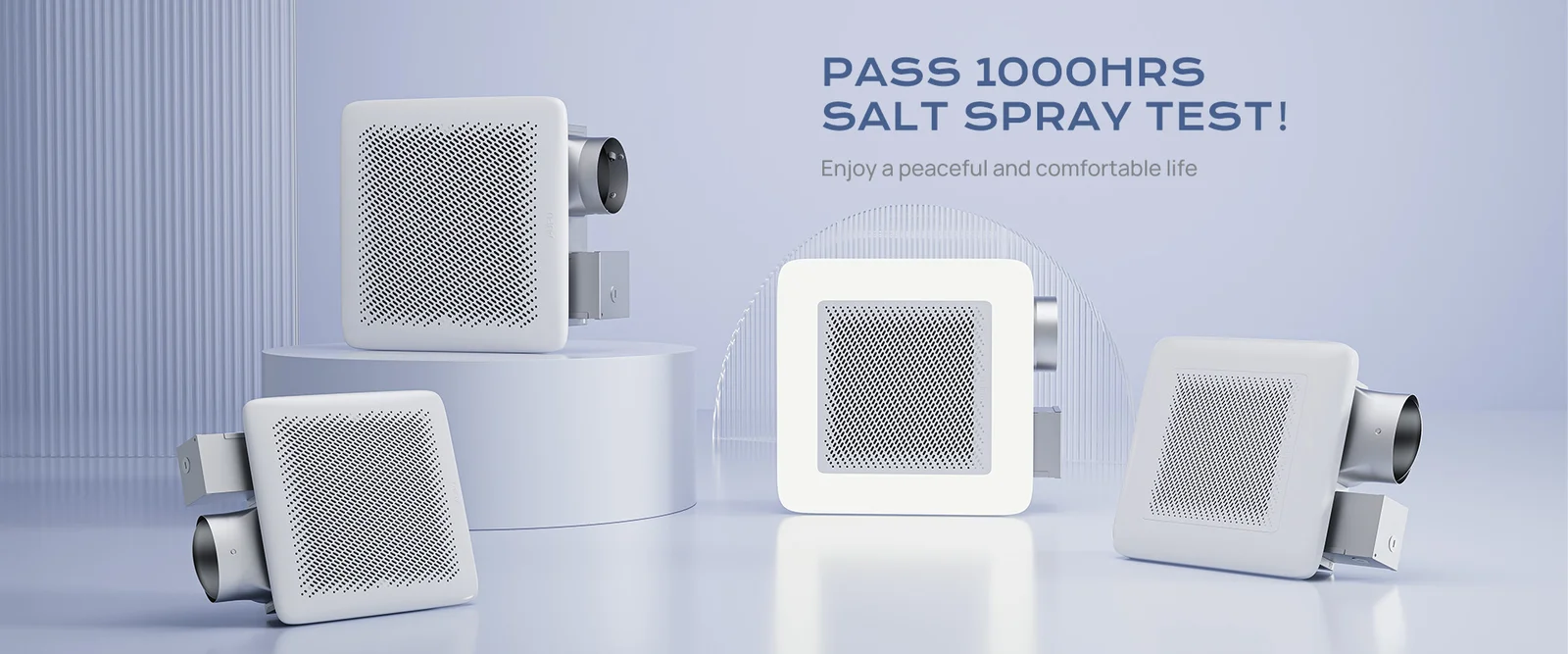

A bathroom exhaust fan with a humidity sensor is one of the smartest upgrades you can make to your home. Unlike standard fans that rely on someone flipping a switch, a humidity sensing exhaust fan turns on automatically the moment moisture levels rise — and keeps running until the air is dry. No more moldy ceilings, no more peeling paint, and no more arguing about who forgot to turn the fan on.
But not all humidity sensing bathroom fans are built the same. Sensor accuracy, CFM rating, noise level, and extra features like LED lights vary significantly between models. This guide breaks down what to look for and which models are worth your money.
How a Humidity Sensor Bathroom Fan Works
A bathroom exhaust fan with humidity sensor has a built-in hygrometer that continuously measures relative humidity in the room. Here's what happens:
- Normal conditions (below the set threshold): The fan stays off or runs at a low background speed.
- Humidity spike (hot shower, steamy bath): The sensor detects the rapid rise and automatically switches the fan to full speed.
- After the shower: The fan keeps running until humidity drops back to the target level — typically 30-60% relative humidity — then shuts off or returns to low speed.
This hands-free operation matters more than you'd think. Studies show that in bathrooms without automatic ventilation, the fan only runs about 30% of the time it should. A humidity sensor eliminates human forgetfulness entirely.
Humidity Sensor vs. Timer vs. Manual Switch
| Control Type | How It Works | Best For | Downside |
|---|---|---|---|
| Manual switch | You turn it on and off | Guest bathrooms, powder rooms | People forget to use it |
| Timer | Runs for a preset duration | Rental units, predictable use | May run too long or too short |
| Humidity sensor | Auto-detects moisture and responds | Family bathrooms, master baths, rentals | Higher upfront cost (pays off in mold prevention) |
For a deeper comparison, read our humidity sensor vs standard bathroom fan guide.
5 Features to Look for When Buying a Humidity Sensing Exhaust Fan
1. Adjustable Humidity Threshold
The best bathroom exhaust fan with humidity sensor lets you adjust the trigger point. Fixed-threshold sensors (usually set to ~60% RH) work fine in moderate climates but can be problematic:
- In humid regions (Florida, Gulf Coast, Southeast Asia): Ambient humidity alone may be 65-70%, so a fixed 60% threshold means the fan would run continuously. You need an adjustable sensor you can set to 70-80%.
- In dry climates: You might want the fan to trigger earlier (40-50%) because even moderate moisture can feel uncomfortable.
Look for models that offer an adjustable range from 30% to 90% RH. This flexibility makes a big difference in real-world use.
2. CFM Rating (Airflow)
CFM (cubic feet per minute) measures how much air the fan moves. The rule: 1 CFM per square foot of bathroom, with a minimum of 50 CFM. Here's a quick reference:
| Bathroom Size | Recommended CFM |
|---|---|
| Up to 50 sq ft (small half-bath) | 50 CFM |
| 50-80 sq ft (standard full bath) | 80 CFM |
| 80-100 sq ft (larger master bath) | 100-110 CFM |
| 100+ sq ft or jetted tub | 150+ CFM |
A 100 CFM bathroom exhaust fan is the most popular size for standard family bathrooms. Need help sizing? Use our CFM calculator.
3. Noise Level (Sones)
Sones measure perceived loudness. Here's what the numbers actually feel like:
- 0.3 - 0.5 sones: Barely audible — the quietest bathroom exhaust fans on the market. Like a whisper.
- 0.5 - 1.0 sones: Quiet — you can hold a conversation without raising your voice.
- 1.0 - 2.0 sones: Noticeable but not disruptive — about the level of a refrigerator hum.
- 3.0+ sones: Loud — you'll hear it from the next room. Typical of old builder-grade fans.
If you're pairing a humidity sensor with a fan, prioritize under 1.0 sones. Since the fan runs automatically and often, a noisy unit becomes annoying fast. An ultra-quiet bathroom exhaust fan at 0.3 sones is the gold standard.
4. Built-in LED Light
Many humidity sensing bathroom fans now come with integrated LED lighting. This is a two-for-one upgrade:
- One ceiling cutout serves both ventilation and lighting
- LED modules last 30,000-50,000 hours (15+ years of normal use)
- Many offer selectable color temperature (2700K warm to 5000K daylight)
- Some include a night light mode with a separate circuit
A quiet bathroom exhaust fan with LED light and humidity sensor is the ultimate all-in-one solution — especially for bathrooms with limited ceiling space.
5. DC Motor vs. AC Motor
This is one of the most overlooked factors when choosing a humidity sensor fan:
| Feature | AC Motor | DC Motor |
|---|---|---|
| Energy use | Standard (30-80W) | 70% less (5-25W) |
| Noise | Typically 1.5-4.0 sones | Typically 0.3-1.0 sones |
| Lifespan | ~5-10 years | ~10-15+ years |
| Speed control | Usually single-speed | Variable speed (better humidity response) |
| Upfront cost | Lower | Slightly higher |
DC motor bathroom exhaust fans cost a bit more upfront but save money over time through lower electricity bills — especially important for a humidity sensor fan that may run more frequently than a manually-switched unit.
Our Top Recommendations
Based on the criteria above, here are the best humidity sensing exhaust fan options available:
Best Overall: 110 CFM Bathroom Exhaust Fan with Humidity Sensor
This bathroom exhaust fan with humidity sensor hits the sweet spot for most family bathrooms:
- 110 CFM — covers bathrooms up to 110 sq ft
- Adjustable humidity sensor — set your preferred trigger point from 30% to 90% RH
- DC motor — ultra-quiet operation at 0.8 sones, plus 70% energy savings
- Continuous low-speed mode — runs quietly in the background, ramps up when humidity spikes
This is the model we recommend for 90% of residential bathrooms. It balances performance, noise, and price better than anything else on the market.
Best with Timer: Bathroom Fan with Humidity Sensor and Timer
For bathrooms that need both automatic moisture control and scheduled ventilation, the bathroom fan with humidity sensor and timer adds a programmable timer on top of the humidity sensing (available as a configurable option):
- Set the timer to run 10/20/30/60 minutes after a shower regardless of humidity reading
- Dual protection: sensor catches moisture spikes + timer ensures minimum runtime
- Ideal for rental properties and Airbnbs where guests may not understand the system
- Available in 80 CFM and 110 CFM configurations
Best for Wholesale & Bulk Orders: OEM Humidity Sensor Exhaust Fans
If you're a contractor, property manager, or distributor buying in volume, our wholesale exhaust fan OEM program offers humidity sensor models with:
- Custom branding and packaging
- Adjustable sensor specifications to match your regional climate
- Bulk pricing on orders of 50+ units
- Choice of voltage (110-240V) and plug types for international markets
Browse our full bathroom exhaust fan collection to compare all models.
Installation: What to Expect
Installing a bathroom fan with humidity sensor is similar to installing a standard fan, with two important differences:
- Constant power required. The humidity sensor needs power at all times to monitor the air — even when the fan isn't running. Most models wire to a single switch but draw a tiny standby current (typically under 0.5W). If your current fan is on a switch loop, a minor wiring adjustment may be needed.
- Sensor placement matters. The sensor is built into the fan housing, which sits in the ceiling. Make sure the intake grille isn't blocked by a ceiling beam or too close to the shower head (direct water spray will damage the sensor). The ideal position is centered in the bathroom ceiling or directly above the shower area.
For a complete step-by-step walkthrough, read our bathroom exhaust fan installation guide. Most DIYers can replace an existing fan in 2-3 hours.
If you're wondering about cost, check our breakdown of installation costs by scenario (DIY vs. hiring an electrician, new install vs. replacement).
Humidity Sensor Fan Maintenance
These fans need minimal upkeep, but two things will keep yours running perfectly for years:
- Clean the sensor lens every 6 months. Dust buildup on the sensor can cause it to misread humidity. A quick wipe with a dry microfiber cloth is all it takes. Don't use sprays or liquid cleaners — they can damage the sensor element.
- Clean or replace the grille filter annually. The intake grille traps dust and lint. If it clogs, airflow drops and the fan works harder. Most grilles pop off without tools — rinse with warm water, dry completely, and snap back on.
FAQ
Is a humidity sensor bathroom fan worth the extra cost?
For family bathrooms, master baths, and rental properties — yes. The cost difference is typically $30-60 over a comparable non-sensor model. Considering that mold remediation costs $1,500-3,500 on average, a humidity sensor fan is cheap insurance. It also eliminates the "did someone forget to turn the fan on?" problem permanently.
Can I add a humidity sensor to my existing bathroom fan?
You have two options. Some manufacturers sell add-on humidity sensor modules that wire into the fan circuit, but compatibility is limited. The more reliable approach is replacing the entire fan with a built-in humidity sensor bathroom exhaust fan. The sensor and motor are designed to work together, and installation is cleaner.
Will the fan run all the time in a humid climate?
If the threshold is set too low, yes. This is why an adjustable sensor is critical for humid regions. Set the trigger to 70-80% RH instead of the default 60%, and the fan will only activate for actual shower-level humidity spikes, not ambient moisture. All of our recommended models above include adjustable thresholds.
What is the best bathroom exhaust fan with humidity sensor and light?
For a complete all-in-one solution, choose a model that combines a humidity sensor, LED light, and quiet DC motor in a single unit. The 110 CFM humidity sensor fan is available with an integrated LED panel — one ceiling cutout handles ventilation, lighting, and automatic moisture control. It's the cleanest solution for bathrooms that need everything.
What CFM do I need for a bathroom with a shower?
The minimum recommendation is 50 CFM for any bathroom with a shower, and 1 CFM per square foot for bathrooms larger than 50 sq ft. A standard 5' × 8' bathroom (40 sq ft) needs 50 CFM minimum. An 8' × 10' bathroom (80 sq ft) needs 80 CFM. If you have a steam shower or jetted tub, go up one size. Use our CFM sizing tool for a precise calculation.
How long should a bathroom fan run after a shower?
About 20-30 minutes after you finish showering is enough to clear the moisture. This is where a humidity sensing exhaust fan really shines — instead of guessing or setting a timer, it monitors the actual humidity and shuts off when the job is done. No wasted electricity, no leftover moisture.
The Bottom Line
A best bathroom exhaust fan with humidity sensor isn't just a convenience — it's one of the most effective ways to prevent mold, protect paint and drywall, and improve indoor air quality. If you're replacing an old bathroom fan or building new, the $30-60 premium for a humidity sensor model pays for itself the first time it prevents a mold problem.
Our pick: The 110 CFM bathroom exhaust fan with humidity sensor — adjustable threshold, DC motor, ultra-quiet operation, and available with an integrated LED light. It's the right fan for most bathrooms.
Browse our complete collection of bathroom exhaust fans or contact us for wholesale pricing.
Disclaimer: This guide reflects general recommendations. Fan sizing depends on your specific bathroom dimensions, climate, and local building codes. Consult a licensed contractor for installations requiring new electrical or duct work.